MindTrack AI — Precision Learning for Every Mind
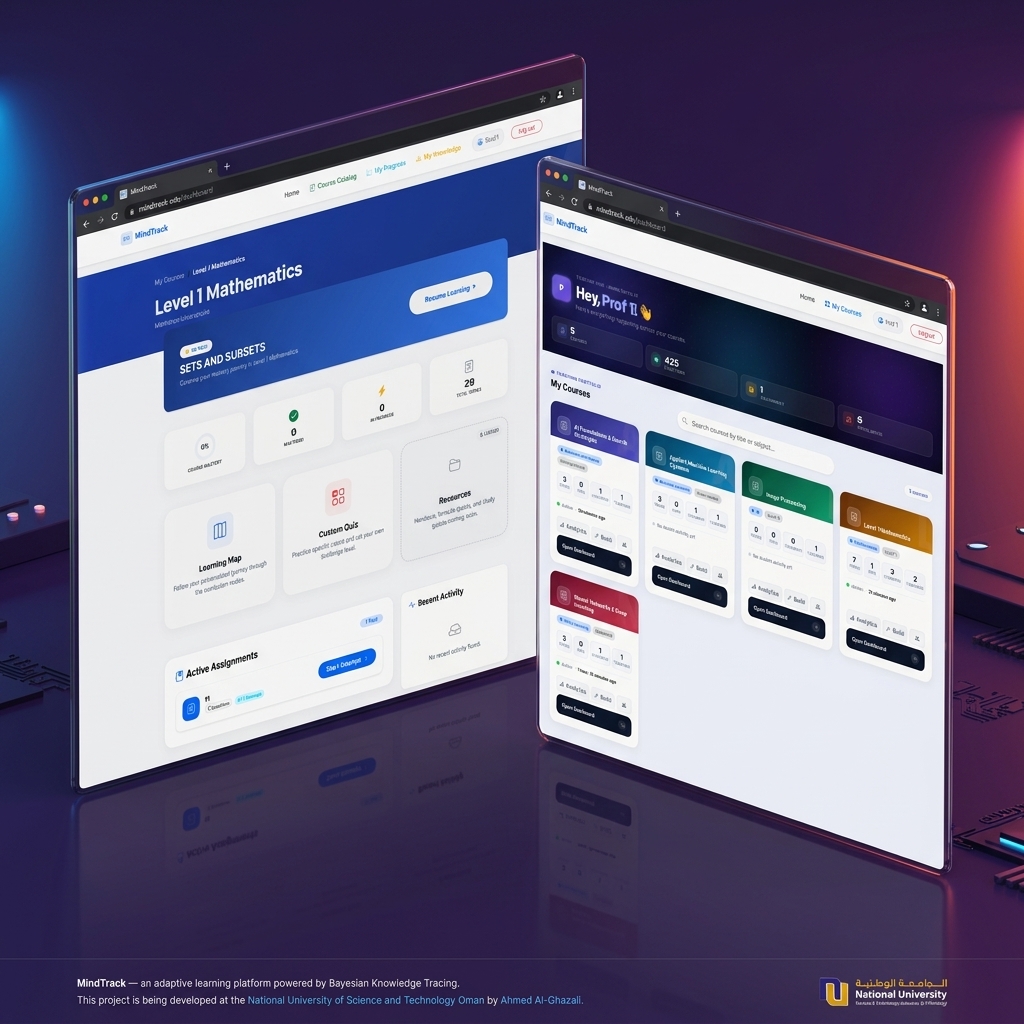
The platform serves three distinct user roles — Students, Educators, and Administrators — each with dedicated dashboards, analytics, and feature sets. From a Duolingo-style learning map to anti-cheating safeguards and teacher heatmap analytics, MindTrack demonstrates how AI can transform the classroom experience.
Project Details
Technologies
Key Metrics
7+
BKT Parameters
3
User Roles
15
Data Models
The Problem
Traditional education follows a one-size-fits-all model where every student receives the same content at the same pace, regardless of their individual mastery level. This leads to several critical issues:
- Students who struggle fall further behind — without real-time diagnosis, teachers cannot identify at-risk students until it's too late.
- Advanced students are held back — static curricula don't allow gifted learners to progress at their own pace.
- Teachers lack actionable data — conventional gradebooks show scores, not understanding. There is no visibility into which specific subtopics a student has mastered or is struggling with.
- Assessment integrity is difficult to maintain — online assessments are vulnerable to tab-switching, copy-pasting, and time manipulation.
The core question MindTrack answers: How can we deliver a personalized, tutor-like learning experience to every student in a classroom, while giving teachers the diagnostic tools they need to intervene effectively?
The Solution
MindTrack is built on three integrated pillars, each targeting a different stakeholder:
1. Student Experience — Adaptive Learning Engine
- Duolingo-Style Learning Map: A visual topic-by-subtopic progression path where topics unlock sequentially upon mastery. Each node displays a real-time mastery percentage with conic-gradient visualization and color-coded status badges (passed, in progress, struggling, or locked).
- Bayesian Knowledge Tracing (BKT): A custom probabilistic engine that estimates each student's mastery P(L) per subtopic in real-time. It features logistic extensions for difficulty-aware guess/slip rates, time-sensitivity adjustments, velocity caps (±0.12 per attempt), consistency gating, warmup damping, and expert detection.
- Adaptive Difficulty: A streak-based algorithm automatically adjusts question difficulty — 2 consecutive correct answers increase difficulty; 2 incorrect decrease it.
- AI-Powered Recommendations: Smart study suggestions categorized as "Needs Review," "Finish Strong," and "Start Next" based on real-time mastery data.
2. Teacher Command Center — Analytics & Diagnostics
- Class Heatmaps: Visual grids showing mastery levels across all students and subtopics, enabling teachers to spot knowledge gaps at a glance.
- Struggle Alerts: Automated flags when a student's P(L) ≤ 0.35 with 4+ attempts, triggering timely human intervention.
- Curated Quizzes & Assignments: Tools to create targeted assessments with configurable attempt limits, time limits, and pass thresholds.
- Grade Exports: One-click Excel exports of student performance data for institutional reporting.
3. Administrator Control — Platform Governance
- User & Course Management: Full CRUD operations for users, role assignments, and course lifecycle management.
- Audit Logging: Immutable audit trail recording every significant action (create, update, delete, login, role changes).
- Platform Health Metrics: Real-time monitoring of enrollment counts, active sessions, and system-wide engagement statistics.
- Research Data Exports: Pseudonymized dataset exports for academic research compliance.
Architecture & Implementation
MindTrack follows a monolithic Django architecture with clear separation of concerns:
- Backend: Django 4.2 (LTS) with Python 3.14, using a single "core" app housing all models, views, and business logic.
- BKT Engine: A dedicated
bkt.pymodule (299 lines) implementing extended Bayesian Knowledge Tracing with logistic sigmoid transformations for real-time parameter adaptation. - Database: PostgreSQL in production (SQLite for development), with 15 interconnected models using UUID primary keys for security and portability.
- Frontend: Server-rendered Django templates with Bootstrap and vanilla JavaScript for rich interactivity including real-time mastery visualizations.
- Authentication: Email-based auth with OTP verification (hashed via Django's
make_password, never stored in plaintext), rate-limited endpoints, and role-based access decorators. - Security: Anti-cheating mechanisms (tab-focus monitoring, session tracking, security violation logging), CSRF protection, and comprehensive input validation.
- Deployment: Gunicorn + WhiteNoise for static files, Render/Railway-ready with environment-based configuration.
The UI follows a premium "Violet Dark Mode" aesthetic with glassmorphism effects, smooth animations, and full mobile optimization with specialized LaTeX rendering for mathematical formulas.
Results & Impact
- Personalized Learning at Scale: Every student receives an individually tailored learning path that adapts in real-time based on their demonstrated mastery — no two students follow the same trajectory.
- Early Intervention: Struggle alerts and class heatmaps enable teachers to identify and support at-risk students before they fall irreversibly behind.
- Assessment Integrity: Built-in anti-cheating mechanisms (multi-tab detection, focus-loss tracking, forced termination) ensure honest performance measurement.
- Data-Driven Teaching: Teachers gain granular visibility into subtopic-level mastery across their entire class, transforming instruction from intuition-based to evidence-based.
- Production-Ready Platform: Full role-based access control, OTP authentication, audit logging, GDPR-aligned data exports, and deployment-ready infrastructure.