Gymee — Unified Fitness Intelligence Platform
Gymee is an all-in-one fitness and nutrition ecosystem that consolidates workout logging, professional coaching, and scientific nutritional tracking into a single, high-performance web application. Built with Django 6.0, it serves both individual athletes and professional personal trainers.
Gymee solves the app fragmentation problem in fitness by providing a centralized hub for exercise data, nutritional guardrails, and coach-client relationships.
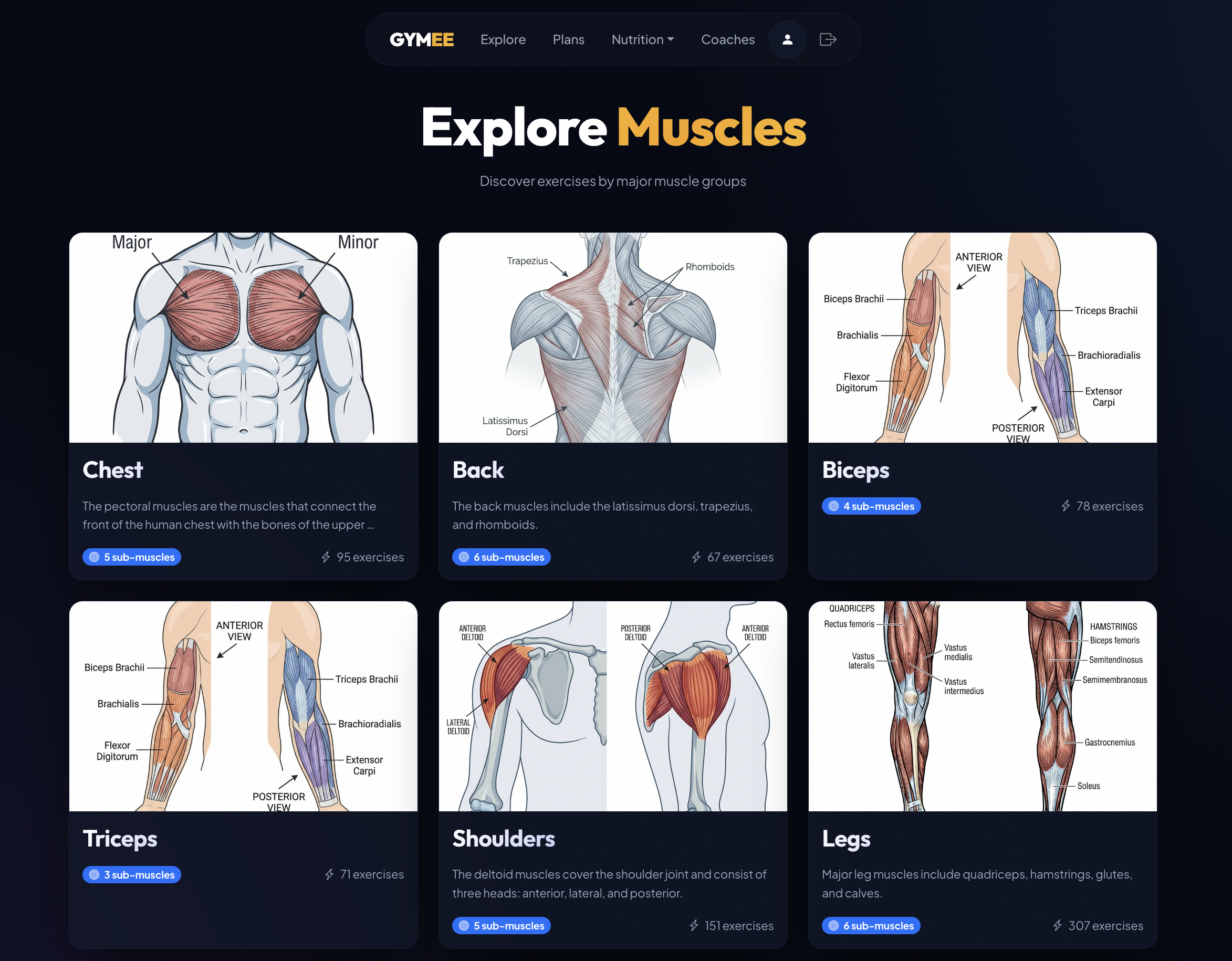
Project Details
Technologies
Key Metrics
1,746
Exercise library
15+
Muscle sub-groups
Per set
Real-time PR detection
Goal-based
Adaptive macros
The Problem
Most fitness enthusiasts juggle multiple tools: a calorie tracker, a workout logger, an exercise-form library, and WhatsApp/Email for coach PDFs. This fragmentation leads to:
- Data silos: Gym progress is disconnected from nutrition targets.
- User friction: Beginners struggle to find the right exercises and understand muscle targeting.
- Coach inefficiency: Trainers lack a real-time dashboard to monitor adherence and performance.
The Solution
Gymee provides a unified Fitness Intelligence pipeline:
- Integrated calculator: Users set their biological metrics once; the system generates adaptive daily guardrails (macro targets).
- Active session logging: Mobile-responsive workout logging with real-time “previous best” context to motivate progression.
- Coach-client workflows: Coaches can remotely assign and modify workout plans, keeping training consistent and measurable.
Architecture & Implementation
1) Automated exercise ingestion
To populate a 1,700+ exercise library, I built a robust ingest_exercises pipeline that:
- Syncs with open-source exercise datasets via JSON APIs.
- Atomically downloads and maps exercise media to local storage using Pillow.
- Normalizes unstructured inputs into a strict MuscleGroup hierarchy.
2) Scientific nutritional engine
The nutrition module implements the Mifflin–St Jeor equation:
- BMR: gender, weight, height, and age.
- TDEE: activity multipliers from 1.2× to 1.9×.
- Macros: goal-based protein/fat/carb splits (e.g., higher protein targets for weight loss).
3) Real-time progress tracking
The workouts module uses a set-level SetLog system to monitor every recorded set. When a user exceeds their previous best for weight or reps, the system flags a New PR and visualizes it on the dashboard using Chart.js.
Results & Impact
- Centralized data: Reduced reliance on external calorie trackers and PDF-based workout plans.
- Guest-to-member conversion: Session-based storage lets guests try the macro calculator and exercise search before account creation.
- Scalable content: Automated ingestion enables library growth without manual data entry.
Next steps
- Wearable integration: Sync heart rate and calorie burn from Apple Health / Google Fit.
- AI form analysis: Browser-based computer vision to detect posture issues during lifts.
- Social features: Community leaderboards for key lifts (e.g., deadlift PRs).