AnemoCare — AI Anemia Management
Chronic Kidney Disease (CKD) is a progressive condition characterized by gradual loss of renal function, leading to multiple complications including anemia. Managing anemia effectively is crucial as it impacts patient quality of life, treatment costs, and overall survival. Traditional anemia management strategies rely on clinical experience and iterative dose adjustments, which can be inefficient and error-prone. Artificial Intelligence offers the potential to improve accuracy and efficiency in this process. The AnemoCare system applies AI to automate hemoglobin trend prediction and ESA dose optimization. Through machine learning and explainability tools such as SHAP, physicians can gain transparency into model reasoning while reducing workload and enhancing decision reliability.
Objectives and Scope
The main objectives of the AnemoCare project are as follows:
- Develop predictive models to estimate future hemoglobin levels.
- Optimize ESA dosing recommendations through regression and uncertainty modeling.
- Integrate OCR-based data extraction to reduce manual data entry.
- Provide role-based system access for healthcare professionals and patients.
- Ensure model interpretability through explainable AI methods.
- Deploy the system in a secure and modular architecture.
Project Details
Technologies
Key Metrics
94%
OCR accuracy
1090
Patient visits digitized
0.6
Hb MAE
The Problem
Recent advancements in AI and ML have significantly contributed to improving anemia management in patients with CKD. Several studies have focused on predicting hemoglobin (Hb) levels and optimizing ESA dosages through data-driven methods. However, from the comparative analysis of previous studies, it is evident that most existing AI-based systems concentrate on either predicting hemoglobin levels or optimizing ESA dosing using machine learning techniques such as Artificial Neural Networks (ANNs), recurrent neural architectures, or Model Predictive Control (MPC).
Although these methods have achieved promising results in accuracy and clinical efficiency, they often lack real-world integration, interpretability, and adaptability across diverse patient populations.
For example, the MPC-based approach from the University of Louisville emphasized individualized control but did not include automated data integration or model transparency. Similarly, the European multicenter ANN study successfully stabilized Hb levels but was limited by its black-box nature and absence of uncertainty estimation. The AISACS project in Japan focused on prevention through neural networks but lacked a comprehensive explainable framework. More recent models, such as the GRU-Attention system developed in South Korea, improved predictive accuracy but still operated as stand-alone analytical models without clinical interface deployment.
Research Gap and Contribution of AnemoCare
Despite the progress of prior research, none of the reviewed systems offered a complete clinical decision support solution that combines:
- Personalized hemoglobin forecasting and ESA dose optimization within a unified platform.
- Explainable AI (XAI) tools that provide transparency into the reasoning behind each recommendation.
- OCR-based data extraction for automating the digitization of clinical records.
- Role-based deployment (Doctor, Nurse, Patient, Administrator) for real-world usability and scalability.
The Solution
To address these limitations, AnemoCare introduces an integrated AI-powered framework for anemia management in CKD patients. Its core innovations include:
- Utilizing regional clinical datasets from the Middle East to enhance model generalization and relevance.
- Incorporating deep learning and probabilistic models with uncertainty estimation for safer medical recommendations.
- Embedding explainable AI methods (e.g., SHAP) to increase physician trust and interpretability.
- Developing a modular mobile and web architecture (Flutter and Django) that bridges data-driven analytics with practical clinical workflows.
Dataset and Preprocessing
Data were collected from three hospitals, covering 79 CKD patients (≈300 visits). The dataset included features such as Hemoglobin, Ferritin, TSAT, TIBC, and ESA doses. Due to extensive missing data, the Last Observation Carried Forward (LOCF) method was used for imputation after consultation with medical experts. Feature engineering introduced temporal lag features, rolling averages, and clinical flags to improve model interpretability.Proposed Models
Multiple models were explored for prediction and recommendation tasks:
- GRU (Gated Recurrent Unit): Captures temporal relationships with fewer parameters.
- LSTM (Long Short-Term Memory): Handles long-range dependencies in patient data.
- XGBoost: Gradient boosting model used for regression and quantile estimation.
- Gaussian Process Regression (GP): Selected final model due to its uncertainty estimation and interpretability.
Architecture & Implementation
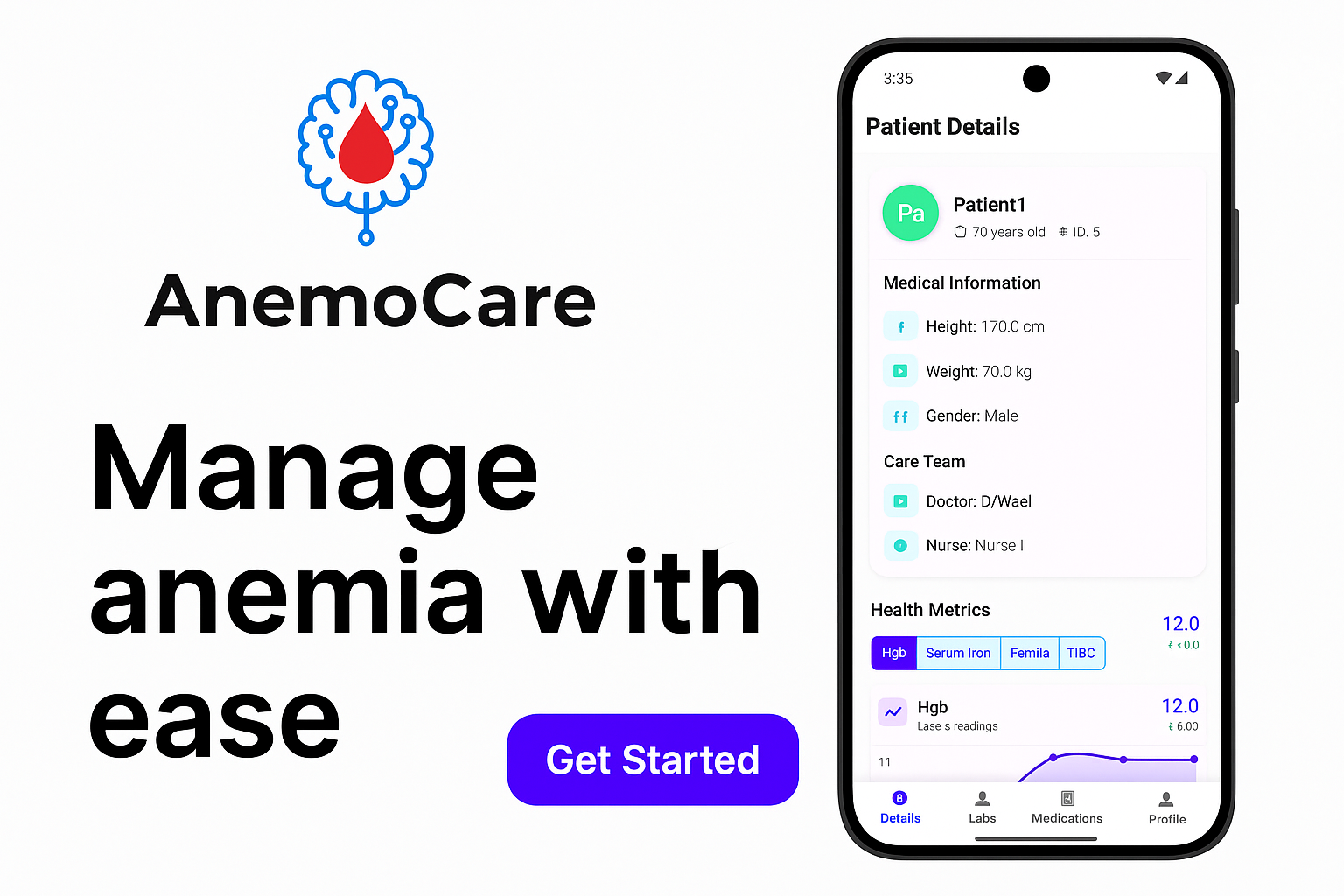
The system combines a Django REST backend with a Flutter mobile frontend. The backend manages user authentication, data storage, and API communication, while the Flutter app enables user interaction. Doctors can upload lab images for OCR extraction or manually enter data. The AI engine predicts Hb and recommends ESA doses, which doctors can review before confirmation.
The complete mobile application source code is available on GitHub.
Results & Impact
The Gaussian Process (GP) and XGBoost models achieved the best balance between accuracy and interpretability. GP provided reliable uncertainty estimates, crucial for safe medical recommendations. Model performance metrics:
- Mean Absolute Error (MAE): 0.65
- RMSE: 0.97
- R² Score: 0.58
For the OCR, accuracy improved from 65% to 95% after KAZE-based preprocessing, ensuring accurate digitization of medical records:
- Original image: 65%
- Using Global threshold: 62%
- Using Adaptive threshold: 67%
- Using Key-point based perspective: 85%
- Using Key-point based perspective and adaptive threshold: 95%
Conclusion and Future Work
AnemoCare demonstrates the potential of Artificial Intelligence to transform anemia management in patients with Chronic Kidney Disease (CKD). By combining deep learning, probabilistic modeling, and explainable AI, the system delivers accurate, transparent, and clinically interpretable predictions for hemoglobin levels and ESA dose recommendations. The integration of OCR and a modular mobile–web architecture further enhances usability and adaptability in real-world clinical environments.The current version of AnemoCare has been developed and validated using data collected from a single hospital in Egypt, which provided valuable insights into the feasibility and accuracy of the proposed models. However, to ensure broader clinical applicability and improve model robustness, future work will focus on retraining and validating the system using data aggregated from multiple hospitals across Egypt and other Middle Eastern countries.